Sam Crimmin / Medical Officer / South Georgia
A trip into the wild usually means fantastic scenery but how often do you look up? Even in the middle of the night there is far more to see than the tent ceiling. Away from light pollution the night sky can be spectacular. During 18 months in the Antarctic I tried to learn how to photograph it. What I discovered was that astrophotography takes a bit of practice and a lot of patience. But get it right (and I’m not saying I have yet) and the camera can pick up some amazingly detailed starscapes. These are my top tips for nightime landscape photography.


Location and time of year
Pick somewhere dark! The further away from natural light the better. On South Georgia I was 900 miles from the nearest city. Avoid moonlight unless you are aiming for star trails. Winter is better. In the winter the sun dips further below the horizon but in summer time the camera will pick up its light even if the naked eye cannot.
Type of Camera
Astrophotography will only really work with a digital SLR as it requires a good deal of fiddling with the settings. Also, the lower the camera noise the better the images. Mine were all taken with a Canon 5D MKII full frame SLR.
As the exposure times will be long you will also need a sturdy tripod.
Setting up the shot
If it is too dark to see through the view finder I put the ISO right up (25,600 on my camera) and take a few test shots, then use the LCD image to adjust the camera position. By increasing the ISO a test shot can be captured in 4-5 seconds rather than 30s saving both battery and time.
Choosing the settings
The f-number will depend on your lens. My night sky pictures were taken with a Canon 17-40 L f4 on a full frame body. Most lenses work best when stopped down a bit, therefore for me f5 or f5.6 seemed to work best.
If you are lucky enough to have a faster lens you can decrease the f number. I have managed to get some good images with the lens at f4 and this may be necessary if it is a very dark night. It’s probably better to go to f4, before heading above an ISO of 3200.
Focus
Most cameras are set up to automatically focus, but at nightime this won’t be possible. Instead, manually set the focus at infinity then come back just a little, as most modern lens actually go past infinity to allow the autofocus to work.
Once you have done this take a test picture and then use the LCD screen to zoom in on a star. Adjust the focus in fine increments until the image is sharp. Once you have done this a few times you will learn where the best focus point is. Take your time doing this as it’s the most important bit to get right.
Length of exposure
The closer you are aiming to the pole star (Southern or Northern!) the longer exposure you can use. That said anything over 30 seconds and you will start to get too much star trailing. This can be an issue, as if you shorten the exposure then you will need to up the ISO.
Star trails
Star trails are created as the earth’s movement gives the impression that the stars are spinning through the sky. A long exposure, 90 minutes plus, can create a star trailing effect. This is best achieved on a moonlight night as it allows the camera to capture the detail of the landscape as well.
An alternative to a long exposure is to use an intervolameter. My picture of the star trails over the Harker glacier was actually a series of 175 x 30 second exposures (ISO 1600 f5.6) superimposed. Using this technique it is possible to take out any frames that might ruin the image, for instance someone leaving the tent to pee!
For PC users there is a brilliant program at www.startrails.de. I have not yet found a Mac equivalent but Photoshop can be used to the same effect. It would take a lot of writing space to explain the details of post-production here but a good website for more information is www.astropix.com.
The moon
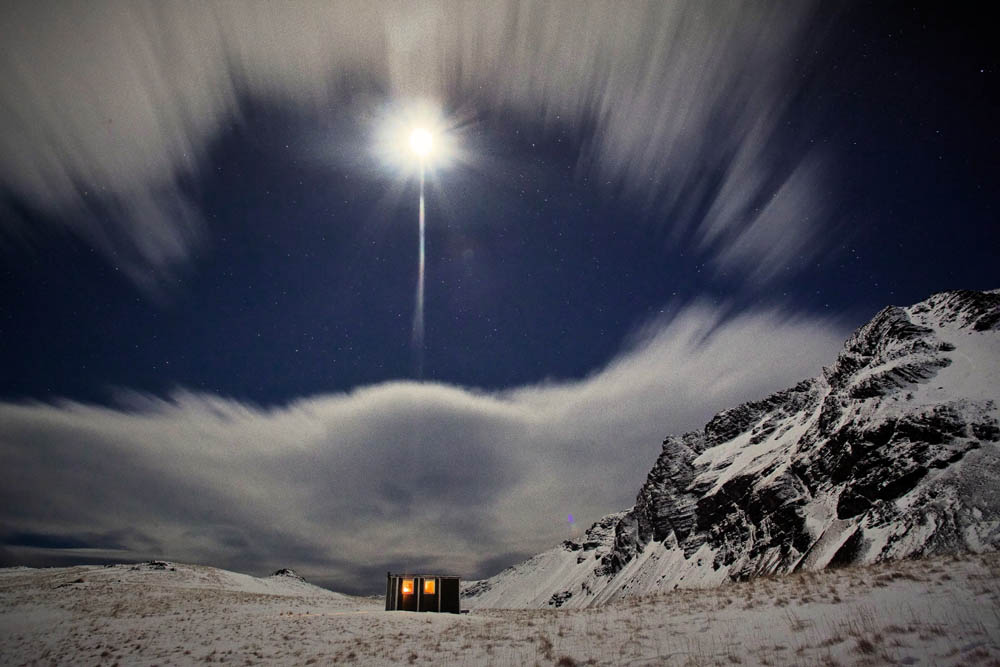
Two words: spot meter! The moon is extraordinarily bright in a very dark sky. If you have your camera on Evaluative Metering you will never get any detail.
To increase the crispness of the shot use a remote to activate the camera and switch off image stabilisation. This may seem counter-intuitive, but with a camera on a tripod the lack of movement can confuse the image stabilisation and add shake to the image. Using the mirror lockup feature may also help increase crispness.
Example Settings
Dark Nights / Dark nights are best for Milky Way detail, try to get the ISO down if you can. Try ISO 3200, Aperture F5 and Shutter Speed 30 secs.
Moonlight / If there is a lot of moonlight you won’t get good milky way images, so maybe try star trails instead? ISO 1250 Aperture F5.6 Shutter Speed 30 secs.
To see more of Sam’s amazing night sky images, please visit her website.